Showing posts with label Point Pleasant. Show all posts

Appalachian Adventures (Final Chapter): Tu-Endie-Wei, Zoar, and Beer along the Muskingum

Our visit to Point Pleasant, WV, showed us to our pleasing surprise that this little river town has a bit more to offer outside of the Mothman mythos. One was already written about in regard to the U.S. Navy Poster Museum; this final post on our trip talks about the history behind Tu-Endie-Wei State Park.

Ohio itself has plenty of history to go around; while our earlier visit to The Serpent Mound detailed this state's original inhabitants, our visit to the Zoar Historical Village detailed one of one of the more unique groups of European settlers to set up their home within this state's borders.

In between these two visits, we dropped into Marietta, the first permanent settlement northwest of the Ohio River, to check out where the locals drop by for some locally brewed beer and pub grub.

From the Wyandot word for "point between two waters", Tu-Endie-Wei
State Park in West Virginia turned out to be much more than a pretty view
Tu-Endie-Wei State Park:  The point of land that holds this state park would be a in-the-area destination if only for the pretty view, combining multiple river bridges as well as the confluence of the Kanawha and Ohio Rivers. But the impossible to miss monument centered on this property gives the visitor the hint that there's something much more to this piece of land other than pretty views and nicely manicured greenery.

Although unintended, our visit to the park came on a rather momentous day: roughly 240 years prior, what some historians have dubbed the first battle of the American Revolution took place upon this Point Pleasant site on October 10, 1774. At that time, clashes with Indians were commonplace, and seen by American forces as possibly detrimental in a possible conflict with mother country Britain, especially if Britain were to ally with the natives.

After signing a peace treaty with Iroquois Nation and Delaware tribes, Governor of Virginia Lord Dunmore meant to quell rebellious Shawnee and Mingo tribe factions to the south, led by Chief Cornstalk, by teaming up with appointed commander of Virginia's militia, Andrew Lewis. Suffice it to say, the battle was brutal (300 deaths spread between both forces) but successful for the colonists, as it led to a treaty where Shawnee and Mingo forces would remain neutral in any American-British encounter.

Numerous monuments related to the signature battle which occurred
on park land, the Battle of Point Pleasant, are scattered around the park.
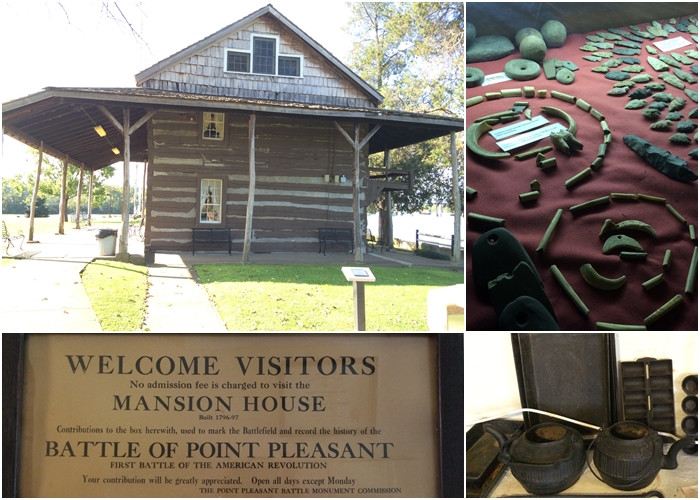
Also located at the park is Mansion House, the oldest hewn log house in the area (and originally run as a tavern) that has been preserved and turned into a museum run by the local chapter of the Daughters of the American Revolution. Open from May to October, it does not look like much from the outside and actually looks on the smallish side, but the visitor will find more artifacts, bits of local history and other items of interest stuffed within this building's multi-leveled interior than one might think.

On a side note, if you do get the chance to walk along the river on the Point Pleasant side, be sure floodwall murals (similar murals reside in other towns further down river such as Portsmouth, OH and Covington, KY), which provide a artistic rendition of life along the river as well as important historical events in the area, including those which took place at Tu-Endie-Wie.


Tu-Endie-Wie State Park
1 Main Street
Point Pleasant, WV 25550
Facebook     Website


The Zoar Store, where most people's tour of this historic
Ohio village just north of Dover starts

Zoar Historic Village: Located just northeast of Dover and New Philadelphia, Ohio, the historic settlement of Zoar provides an incredibly detailed look at a unique group of settlers who made their communal way of living work for over over 80 years.

Formed by a group of 200 separatists escaping religious persecution in their home country of Germany, Zoar Village was founded in 1817 with a communal arrangement. In something of a Cliff Notes version of basic operations, Zoar society members were assigned tasks to keep the village functioning, and all goods produced were shared equally among all in the village. All needed goods and wares were produced among community members, and with the generally rough living conditions and the need to conserve limited resources, a philosophy or reusing goods and building things to last was commonplace among members of the village.

We had previously visited a similar town/state park in the Gold Country of California in the historic town of Columbia, and there are definitely some similarities to these two places. However, we found that Zoar had a more down-to-earth quality to it, and the exhibits that were opened (coming during off-peak tourist season and a Sunday meant that some exhibits were closed) gave us a more detailed look at what the hardship the original settlers must've felt versus the cleaned-up view of mining life that Columbia presented.

After checking in at the Zoar Store/Visitors Center (here you can purchase souvenirs as well pay admission for a wristband that will let you into all the open exhibits), we walked two blocks to the Town Hall, one of the last buildings built by the society and currently home for two museums. After a helpful video introduction to the Zoar society, we wandered through this two story building and saw a rather extensive collection of tools and personal artifacts gathered from the original Zoar settlers.


The well-preserved nature of many of these items is a tribute to the Separatists' mantra of taking care of their belongings and creating them to last. This building also holds items for the Ohio & Erie Canal Museum: Zoar and Bolivar were on the southern stretches of this transportation pathway from the Lake Erie region, proving especially vital for the first couple or three decades for Zoar settlers (the canal's importance declined starting in the 1850s when the railroad became the dominant mode of transport of goods and people throughout the country.)

Next, we ventured to the Number One house (residential houses were originally numbered to help make the distribution of goods an easier process) where society founder Joseph Bimeler and Zoar trustees once resided. Within this solidly built house (this can be visually seen quite well when touring the basement) visitors can get not only an idea about the functional quarters the settlers lived with, but also the laundry areas as well as the magazine, where goods were stored and available to distribution to all village residents. One also can further sample the great craftsmanship within various collective members, with perhaps the most striking being in the organ handcrafted by Peter Bimeler, great grandson of Joseph and the miller for Zoar during its later years of existence.


Other exhibits, original Zoar houses turned into private residences (while they are not open to the public, visitors are free to walk through the streets and view these 19th-century era homes) and businesses (including a tavern and a bed and breakfast) are scattered throughout the village. However, the undeniable centerpiece of the village remains the Zoar Garden. Anchored in the center by a large spruce tree (meant to symbolize everlasting life), the garden acted then as both a spiritual haven (the numerous paths emerging from the center are representative of paths to Heaven) and a source of sustenance to village members (the grounds then and still grow vegetables and fruits.)  On this sunlit day, we couldn't help wander through this area and feel at peace with life in general, free to ponder what the original settlers were thinking dozens of years ago as they did the same.


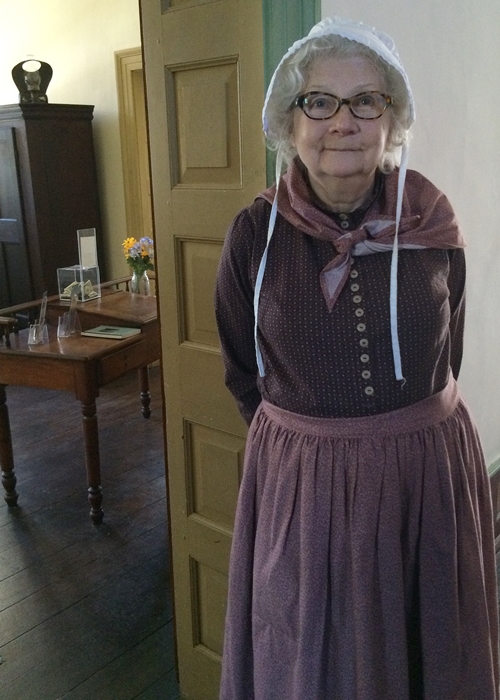
While the original Zoar collective officially disbanded in 1898, the pride in what those original members were able to accomplish in their nearly 70 years of existence remains strong today with their descendants. We felt fortunate to experience that while chatting with one of the village's current docents, who had set up shop inside Number One House to guide that day's visitors. We learned that she was descended from the Bimelers of Zoar, and her obvious excitement in being able to relate her family's history to visitors like us in the actual living quarters of her ancestors was palpable and heartwarming. This conversation, above all, may have been the most satisfying moment of our exploration of this unique bit of Ohio history.

Zoar Historical Village
198 Main St
Zoar, Ohio 44697
(330) 874-3011 or (800) 262-6195
Facebook     Twitter     Website


Marietta Brewing offers a solid brew and grub option
for this river town's resident in the heart of downtown
Marietta Brewing Company - The town of Marietta, sporting 14,000 people at the last Census count and holding the distinction of the first American settlement northwest of the Ohio River, can be a bit confusing for first-time travelers coming north on Ohio State Route 7. After having West Virginia on the other side of the river for pretty much the entire route, I found myself a bit confused having to cross a bridge to get into Marietta, as I thought that we must surely be going into Ohio's neighboring state. Later, I was able to figure out that we were actually crossing the Muskingum River, and that Marietta was firmly ensconced in Buckeye country.

The building in which Marietta Brewing Company (MBC) resides may, for those familiar with the Columbus brewery scene, remind them of the building where Barley's Brewing Company resides. Its downtown location, high ceilings and brick-lined interior are obvious points of reference; the large murals inside MBC are also reminiscent of the posters which line Barley's walls. This brewery, which is the second incarnation of the concept (the first iteration of the brewing company was in 1866 on a site a couple blocks from the current establishment), was like Barley's similarly founded in the 1990s, some five years after Barley's was established in 1992.


Food-wise, MBC treads similar pub grub ground as places like Barley's or Mad Anthony Brewing in Fort Wayne, with a slightly more limited selection but with a pizza option. Obviously, this is a first impression based on just one meal (for my spouse, the steak salad and for me, a veggie pizza) but I'd put the food level somewhere ahead of Mad Anthony's and just slightly behind places like Barley's or even Smokehouse Brewing in Columbus, but more or less in that same class of brewpub grub that's perfectly pleasing with a brew or two.


Marietta also hones its focus in terms of its own brews, rotating its own seasonal around a base of five year-round beers. While the selection may be smaller than most, the beers we had were all at least better-than-average.The standout brew for us was their Esther's Raspberry Wheat, which compares quite favorably to the Razz Wheat that Jackie O's in Athens, Ohio produces. Another solid brew was their Stanleyville Milk Stout, a smooth and creamy rendition with a pleasant maltiness and coffee notes. If MBC's own in-house brews don't appeal to you, a wide variety of mainly bottled craft brews from all parts of Ohio (on our visit, at least two choices from the Cincinnati, Cleveland and Columbus areas were available) from all parts of Ohio and outside the state are available for your drinking pleasure.

Marietta Brewing Company
167 Front St.
Marietta, OH 45750
(740) 373-2739
Facebook     Instagram     Twitter      Website

Marietta Brewing Co. Menu, Reviews, Photos, Location and Info - Zomato

Appalachian Adventures (Pt. 3): The Mothman is Everywhere!

As noted in our last post, we got a good night's rest at the Historic Lowe Hotel the night before a probable meeting with the dreaded Mothman in the sleepy river town of Point Pleasant WV. This, coupled with the great weather on this early fall weekend, led to the feeling of being optimally prepared for any encounters, both fantastic and frightening (on both) as we trekked out for the day.


We started the day with a cup of coffee and a little snack from the Coffee Grinder, which resided catty-corner from the hotel. Like many small town coffee shops, the service was down-home friendly, the space cute and inviting, the baked goods decent, and the coffee a bit on the timid side in brew-strength. But even in these comfortable surroundings, the Mothman's presence permeated the surroundings in the form of their Mothman Brew coffee beans and the house special Mothman Cookie. These latter was too adorable to resist, and we bagged one for a Mothman-loving relative of ours before we left.


Before our main encounter, we thought a good warmup session before would do us a world of good, and the (proclaimed World's Only) U.S. Navy Poster Museum, residing in the Lowe Hotel building just a half-block or so north of the hotel's main entrance, gave us the perfect venue for this. Sporting a uniformed version of the Mothman, this museum's main focus resides in the slightly overgrown hobby of the owner Kelly McCorry Fields.

Fields, a Navy Veteran whose enthusiasm for both her collection and anyone who drops by and visits is unmistakable, has amassed a substantial collection over the years of both original and reprint U.S. Navy-related posters spanning from around World War I to present day conflicts like the Gulf War. Being a Navy brat growing up, my interest was even more acute than my spouse's (who also has family members with military ties) so the posters were a natural draw for me. However, with the modest $3 admission per person, almost anyone can get enjoyment out of this unique collection, from the historical aspects, the artwork within the posters themselves, and just letting Kelly herself give you the inside details behind the museum and the prints within.

Feeling ship-shape and ready for anything after our Naval encounter, we raised anchor and set sail to go to eye-to-eye with the Mothman.


The (proclaimed World's Only) Mothman Museum pretty much lies across the street from the Historic Lowe Hotel (if you haven't figured it out by now, downtown Point Pleasant isn't terribly large.) Aside a plethora of Mothman-related souvenirs in front-of-the-house gift shop (including another Mothman Blend coffee from Silver Bridge, a familiar presence at numerous Columbus-area farmers markets and locally-oriented grocery stores), the museum, curated by Jeff Wamsley, holds a wide collection of media-tidbits, topic-specific exhibits, and other memorabilia that cover the whole history of the Mothman saga to date.


While the museum section of the building would not be considered large-sized by anybody, there is a lot more to see, hear and riffle through than one might think. The mental smorgasbord this provides for Mothman aficionados goes without saying, but the plethora of materials available also helps those unfamiliar or barely familiar with the folklore to soak up the story to their heart's content. Similar to the video presentation given at the Serpent Mound, we found the video presentation in the museum section of the building quite helpful to us Mothman amateurs.

And while there is a certain seriousness to the overall presentation (the true believers in the Mothman wouldn't have it any other way), the right dose of kitsch and fun is added to the mix as exampled by carnival cutouts, comic book style graphics, and a little touch of Hollywood (I mean, who wouldn't want to see the blanket that brushed both Richard Gere and Debra Messing in the 2002 Hollywood-produced movie up close and personal?) Another quite modest admission fee ($3 bucks again) makes the museum in our minds a well worthwhile visit for most.


The Mothman Museum also acts as a centerpiece of the annual Mothman Festival, which had its 14th annual shindig in this town on its traditional third Saturday of September.  Perhaps the other big centerpiece for the festival, located again not too far away (in this case, on a street island lying halfway between the museum and the previously mentioned Coffee Grinder), lies in the rather formidable-looking Mothman statue.

This metallic menace, designed by artist Bob Roach, was dedicated in the second year of the festival and attracts many casual passers-by to this town. The statue is apparently quite sturdy, based on the antics of what looked to be high-school aged teens we saw out the window during our previous night's hotel stay. The construct seemed quite capable of holding some fairly hefty individuals in its arms for some unique photo opportunities.  We're both surmising even the Mothman itself would never have prophesied that it would be so photogenic fifty years after its first sighting.


The Mothman Museum
400 Main St
Point Pleasant, WV 25550
(304) 812-5211
Facebook     Tripadvisor     Twitter     Website

The U.S. Navy Poster Museum
411 Main St
Point Pleasant, WV 25550
(304) 675-4989

Coffee Grinder
330 Main St
Point Pleasant, WV 25550
(304) 593-9922
Facebook     Tripadvisor     Yelp

Appalachian Adventures (Pt. 2): Searching for the Mothman

Were we foolish to seek out the terror that emerged nearly fifty years ago?
Our next stage of our trip had us wary with anticipation, as we crossed over the Ohio River from Gallipolis to the West Virginia side to stay the night in the sleepy river town of Point Pleasant. What happened almost fifty years ago just north of this hamlet has led to a unique folklore (or folk-fact, depending on your point of view) that intertwines a famed bridge collapse, numerous media headlines, a book and a subsequent Hollywood movie, and, in an odd twist, provided a dose of lifeblood that keeps Point Pleasant from fading into the proverbial dustbin of history.

This piece of American folklore is none other than The Mothman, a winged humanoid creature first encountered by two young couples on a dusty road in the old West Virginia Ordnance Works (referred to locals as the "TNT Area") in November of 1966.  For the next year, reports in the local and mainstream media of various sightings, encounters, and other paranormal activity, along with claimed threats by mysterious "men in black" to prevent people from revealing their experiences, were commonplace.

The culmination of these events was the tragic collapse of the Silver Bridge, roughly one year after the initial sighting of the creature. Those who give credence in the existence of the Mothman believe the Mothman was either responsible for or was sent to try to warn the residents of the area of the bridge disaster, since no sightings of the creature were reported in the aftermath.

In many ways, the anticipation for us was not so much a belief or non-belief in the Mothman legend, but rather learning about the legend itself, as much an unexplored entity as the lands we were traveling through this weekend. We had heard about the book by John Keel titled The Mothman Prophecies and the subsequent movie starring Richard Gere based on the book, but otherwise we had little knowledge of the backstory.

Silver Bridge Memorials lie on both West Virginia and Ohio sides of the river
We did want to pay homage of sorts to the disaster which had much a far more wide-ranging effect than its role in the Mothman mythos. The original Silver Bridge, built in 1928 roughly one mile north of where its existing replacement lies, was a unique construct in its silver aluminum-based paint and its highly efficient but low-redundancy single high-strength eye-bar suspension construction. The state-built memorials, also located where the original bridge set down in each state, give simple summaries of the disaster, reference the 46 lives lost in the incident, and are both in need of a little upkeep, especially on the West Virginia side. The effect of the December 1967 bridge collapse had a profound effect; as noted on the West Virginia historical marker, the disaster led to the passage of Federal Government bridge inspection standards the following year.


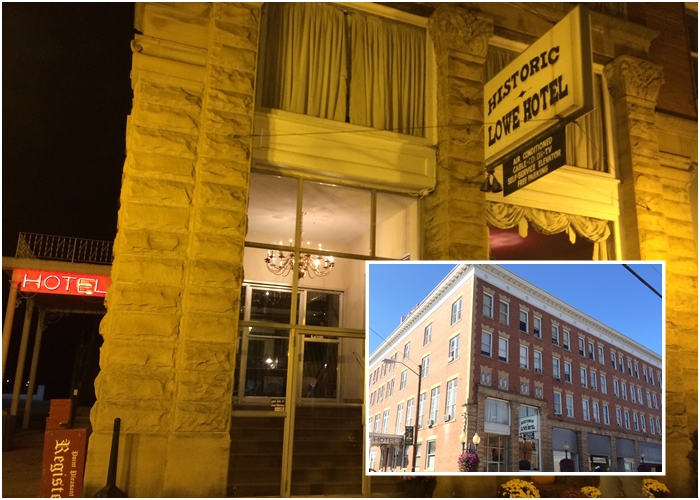
Our stay that night would be at a hotel that has its own encounters with the supernatural. The 114-year-old Historic Lowe Hotel, seated in downtown Point Pleasant, started off as the Spencer Hotel and was a popular stopover port in the days when Ohio riverboat traffic was far more prevalent. According to the blog site Theresa's Haunted History of the Tri-State, the Lowe may be the home to at least five different ghosts.

On one of the few nods to modern convenience, the hotel's website states that the current owners Ruth and Rush Finley, owners of the hotel since 1990, are "upgrading the building and adding
their personal touch to the business." We suspect upgrading will be mostly about maintenance, and there were places in our room that could've used it, from a vent panel propped against the wall, a toilet that didn't quite flush right, and a stray screw in a window sill that either needed tightening or removal. Even the walls were thin, a perfect environment for ghostly moans and laughter to seep throughout the building.

But similar to the Queen Anne Hotel, an old Victorian (supposedly haunted as well) smack dab in the middle of San Francisco that my spouse and I had the pleasure of staying in a few years back, the little quirks and flaws we found were far outweighed by the bygone era touches, such as the period furniture and equipment (the hotel's old telephone switchboard was a neat find in the lobby,) the skeleton keys used to open and lock your room door, or what appeared to be vintage wall sconces.


The personal touch of the owners was in full effect that night.  After checking us in, the owners invited us to their dimly lit hotel bar next door to join the few guests staying for the night for a little impromptu at-the-bar shindig by a local country and bluegrass guitarist, who sported a well-honed, soft Appalachia twang and strummed a mean guitar while knocking out tunes from artists like Garth Brooks and Jimmy Martin. Between songs, Ruth let us know what was in and around Point Pleasant: the Mothman was first and foremost, but there were more things to see and do that actually sounded quite interesting that we tucked into our memory banks

Amazingly, another couple who had checked in after we had that night came by the bar and had never heard of the Mothman or any of the lore behind it, or the fact that hotel itself is said to be haunted by ghosts. After we headed back up to our room, I remarked to my spouse, "I think we're safe now; if there's going to be any haunting, it's going to happen to that poor couple who came in late."

Yes indeed, we slept well that night. We would be well rested for our confrontation with the Mothman.

Silver Bridge Disaster/Memorials
West Virginia Division of Culture & History article
Open University youtube.com video on the Silver Bridge Disaster
Roadside America - Ohio Silver Bridge Eye-bar Memorial

The Historic Lowe Hotel
401 Main St
Point Pleasant, WV 25550
(304) 675-2260
Facebook     Website